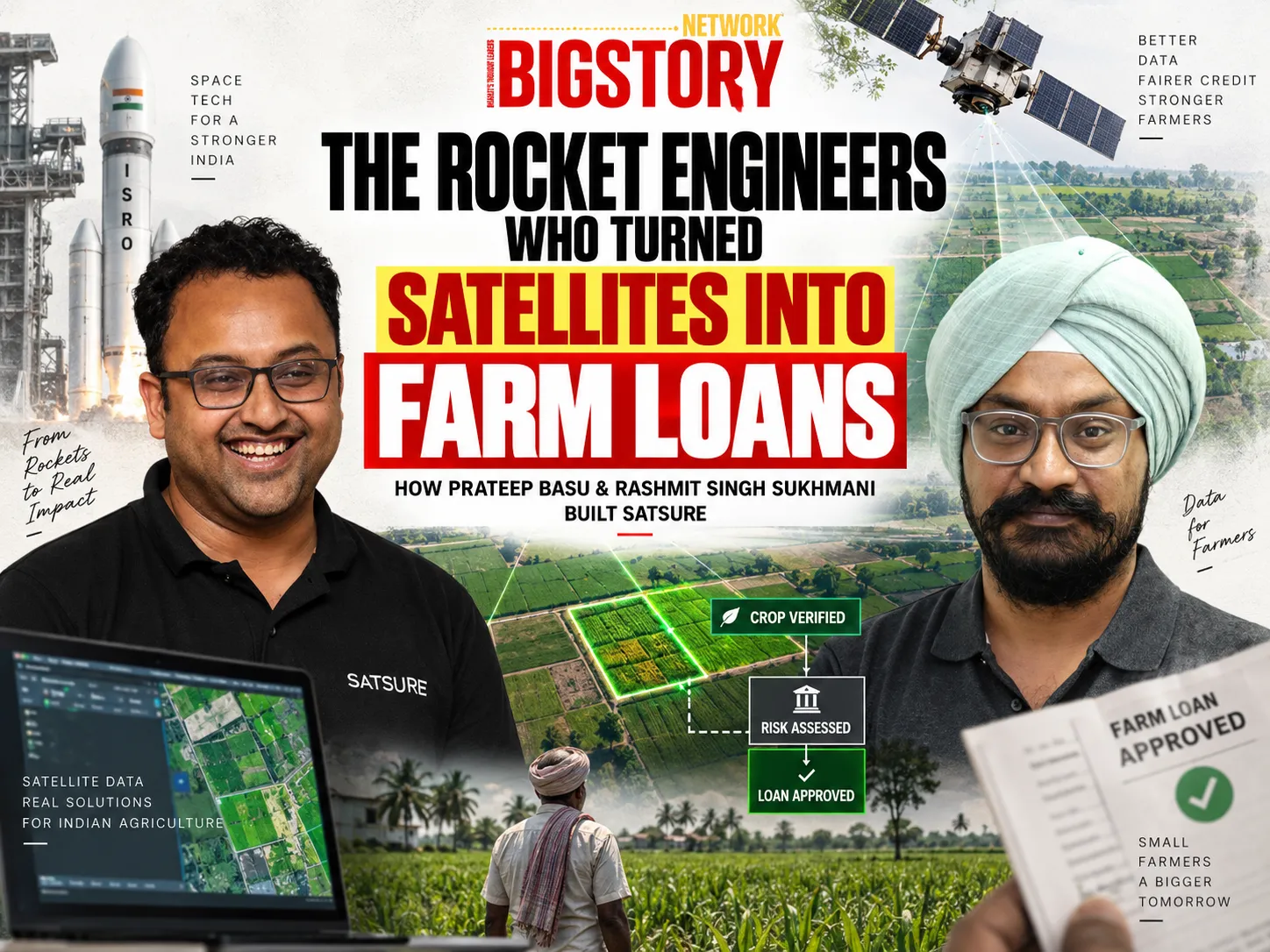
Thirty days, a physical land visit, and a loan officer who may not even recognise the crop — that's what a small farmer faces for credit banks approve for city dwellers in minutes on WhatsApp. Here's the real cost of that gap, and the engineers who decided to fix it.
 Rashmeet Kaur Chawla
Ask a small farmer in India what stops him from getting a bank loan. The answer isn't about his crop. It's about paperwork.
A bank has to send someone to physically visit the land. Someone has to manually check the crop. The loan officer may not even understand what's growing on that one-acre plot. The whole process can take thirty days and often still ends in "no," because the bank simply cannot verify what it cannot see.
Meanwhile, a city dweller with no land and no crop gets a loan approved on WhatsApp in minutes.
Before anyone hears the name SatSure, they're typing things like "why do farmers struggle to get loans in India" or "can satellites help with crop insurance." Nobody searches for a company they've never heard of they search for the problem. And that problem touches a farmer in Andhra Pradesh, a bank loan officer, and an insurance actuary alike.
Prateep Basu didn't set out to fix farm loans. He set out to build rockets. He trained as an aerospace engineer at IIST Thiruvananthapuram, then joined ISRO to work on the GSLV Mk-III, one of India's most powerful rockets. Later, he studied Space Studies in Strasbourg and worked as a space-industry analyst in Boston.
Rashmit Singh Sukhmani followed a similar path. Also an IIST graduate, he worked as a scientist at the Indian Institute of Remote Sensing from 2011 to 2013, studying how to read the earth from space.
Along with a third IIST classmate, Abhishek Raju, the two kept returning to one idea: India didn't need more rocket-building companies. It needed companies that could turn satellite images into decisions banks, insurers, and governments could actually use.
In September 2017, Prateep came back to India, and the three co-founded SatSure in Bengaluru. The idea was simple: satellite data was growing fast, but almost nobody was building tools to make it useful.
Today, SatSure's platform, SatSure Sage, has studied over 2.1 million farmer plots across nearly 195,000 villages. The company has raised close to $27.7 million, works with ICICI Bank, HDFC, and Kotak Mahindra Bank, and is valued at about Rs. 512 crore. A loan check that used to take thirty days can now take under thirty minutes.
None of this came easily.
Their first project was in Srikakulam, Andhra Pradesh made possible only through a letter from a local MP. That letter opened a door. It brought no money. For four and a half years, SatSure ran with no outside funding. Three engineers who understood satellites better than almost anyone had to learn how banks and insurers actually think, and turn that into something a satellite could check. Basu has said the hardest part was never the algorithm — it was this translation.
That's a physics challenge, not a business one. Getting this accuracy to the 90–95% level banks would trust took years. On top of all this, Indian space-tech still faces bigger hurdles: little funding for deep tech, few mentors who have built space businesses before, and launch costs about four times higher than in the US.
Prateep Basu describes it simply: the passion never faded, but what kept them going was a sense of purpose that grew stronger every year. SatSure's founders never set out to be a "space company." They set out to answer one question: does data from orbit make anyone's life better — a farmer's, a lender's, an insurer's? If a satellite image doesn't lead to a fairer loan or a faster payout, it hasn't done its job. Everything else funding, valuation, villages covered comes after that.
What stands out most in this story isn't the satellite technology. It's the jump the founders made.
Prateep Basu and Rashmit Singh Sukhmani were trained to think about rockets and orbits a field that has nothing to do with farm loans, banks, or insurance. Most people who spend years mastering one field stay in it. It's safe. It's what they know.
Instead, these three engineers looked at a completely different world — a farmer struggling for a loan, a bank unable to verify a crop, a system stuck for decades and decided this was a problem worth solving, even though it meant starting over in almost every way. They had to learn how a rural credit officer thinks, how an insurer judges risk, and how a government order actually gets approved none of which anyone teaches you in a space program.
That's the harder kind of courage. Not just building good technology, but walking into a field you don't belong to, sitting with a real, messy, human problem, and putting in the years it takes to actually understand it before you can fix it. Everything SatSure has built since — the accuracy, the funding, the clients — happened only because they were willing to make that jump first. That, more than the satellites, is the real story here.
 Exclusive Content



Sign up for the Daily newsletter to get your biggest stories, handpicked for you each day.


 Trending Now! in last 24hrs